VPN to Change Location Free: What Works and What to Check
Learn how a free VPN changes your apparent IP location, what limits to expect, and how to choose one safely.
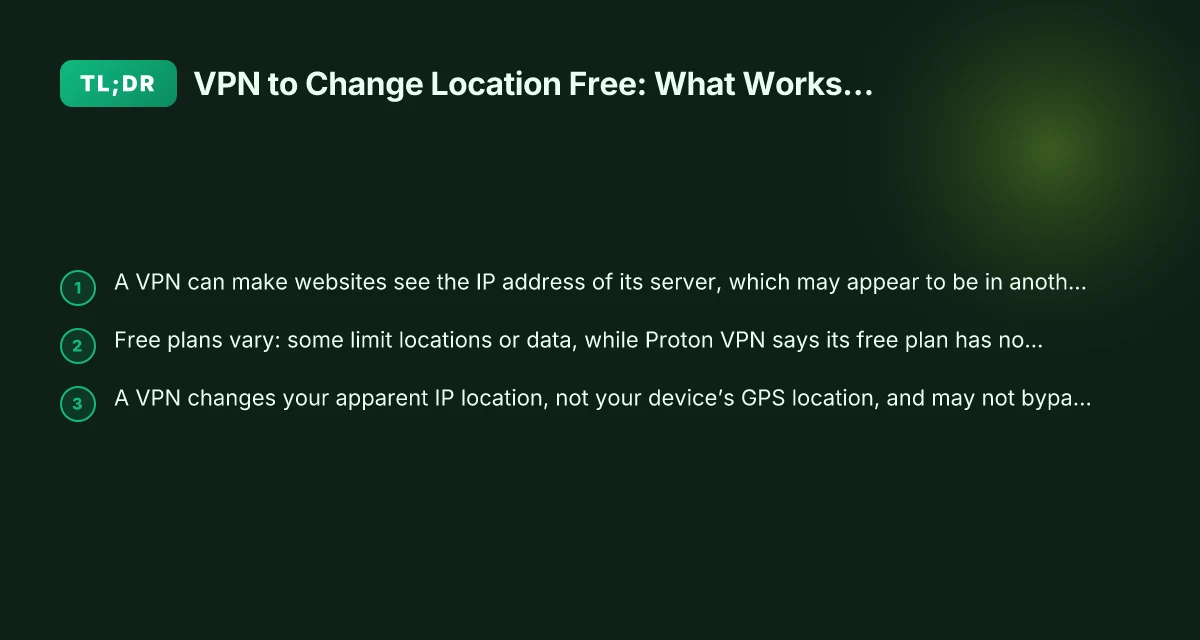
A VPN to change location free can work by routing your internet traffic through a VPN server in another location. Websites will generally see the server’s IP address rather than your usual one, so your apparent location may change. The key is to choose a trustworthy free service that offers a server location you can actually select, and to understand its limits before connecting.
Editor's pick: NordVPN — fast, secure VPN — Strong encryption, a no-logs policy and apps for every device. 30-day money-back guarantee. Get NordVPN →
What changing your VPN location can and cannot change
| Location signal | Changed by VPN? | What it affects | What to check | Example |
|---|---|---|---|---|
| Public IP address | Yes | IP-based location | Check with an IP lookup | Website sees VPN server IP |
| VPN server country | Yes, if offered | Apparent online country | Confirm selected server | Connect to a listed country |
| GPS location | No | Device location services | Review app permissions | Maps may show your real location |
| Wi-Fi or mobile location | Not reliably | Network-based location | Check device settings | Apps may use nearby networks |
| Browser location permission | No | Browser location access | Review site permission | A site may request location |
| Account region | Not necessarily | Account-specific content | Check account settings | Profile country may remain unchanged |
| Cookies and browser data | No | Past sessions and preferences | Clear or review site data | A site may remember prior visits |
| App or site availability | Not guaranteed | Access to services | Check service rules | VPN use may not be accepted |
Compiled November 2026; check the provider's site for current details.
| VPN | Obfuscation | From / month | Plan | Free plan | Refund | Alipay | UnionPay | Crypto | Website opens in China | Trustpilot | |
|---|---|---|---|---|---|---|---|---|---|---|---|
 Proton VPN | Turn on manually Stealth, free plan too | $2.99/mo | 12 months: $35.88 | Yes | 30 days | ✗ | ✗ | ✗ | ✓ | ✗ Blocked | 2.1/5 (1,040 reviews) |
 ZoogVPN | Turn on manually Shadow | $2.49/mo | 27 months: $59.99 | Yes | 7 days | ✓ | ✓ | ✓ | ✓ | Official site blocked; our special link opens (4.4 s) | 4.2/5 (195 reviews) |
 NordVPN | Turn on manually Obfuscated Servers / NordWhisper | $3.49/mo | 27 months: $94.23 | No | 30 days | ? | ✗ | ✓ | ✓ | ✗ Blocked | 4.2/5 (51,628 reviews) |
 ExpressVPN | ✓ On by default all servers | $3.00/mo | 28 months: $84 | No | 30 days | ✗ | ✗ | ✓ | ✗ | ✗ Blocked | 4.4/5 (29,706 reviews) |
 Surfshark | ✓ On by default Camouflage, with OpenVPN | See site | See site | No | 30 days | ✗ | ✗ | ✗ | ✓ | ✗ Blocked | 4.3/5 (31,823 reviews) |
 Astrill VPN | Turn on manually StealthVPN / OpenWeb | $12.50/mo | 24 months: $300 | No | See site | ✗ | ✗ | ✗ | ✓ | ✗ Blocked | 1.3/5 (110 reviews) |
 Private Internet Access | Turn on manually Shadowsocks, OpenVPN only | $2.03/mo | 40 months: $81.2 | No | 30 days | ✗ | ✗ | ✗ | ✗ | ✗ Blocked | 4.2/5 (11,033 reviews) |
 CyberGhost | Turn on manually selected servers | $2.19/mo | 28 months: $61.32 | No | 45 days | ✗ | ✗ | ✗ | ✓ | ✗ Blocked | 4.0/5 (24,178 reviews) |
 PureVPN | Turn on manually switch to OpenVPN | $1.69/mo | 60 months: $101.55 | No | 31 days | ? | ? | ✗ | ✓ | ✗ Blocked | 4.4/5 (17,994 reviews) |
 AdGuard VPN | ✓ On by default TrustTunnel | $2.99/mo | 24 months: $71.76 | Yes | 30 days | ✓ | ✗ | ✓ | ✓ | Official site blocked; our special link opens (3.7 s) | 4.3/5 (290 reviews) |
 Mullvad | Turn on manually QUIC / Shadowsocks / LWO | $5.61/mo | €5/mo | No | 14 days | ✗ | ✗ | ✗ | ✓ | ✗ Blocked | 3.2/5 (192 reviews) |
 Windscribe | Turn on manually Stealth / WStunnel | $5.75/mo | 12 months: $69 | Yes | See site | ✗ | ✗ | ✗ | ✓ | ✗ Blocked | 4.7/5 (13,355 reviews) |
 StrongVPN | Turn on manually Scramble, OpenVPN TCP | See site | See site | No | 30 days | ✓ | ✗ | ✗ | ✗ | ✗ Blocked | 4.4/5 (2,695 reviews) |
 LightXtreme 闪连 | Not listed | $7.08/mo | 12 months: $84.99 | Yes | 30 days | ✓ | ✓ | ✓ | ✓ | ✓ Yes (3.5 s) | No page |
Prices checked 2026-11-10 on each vendor's pricing page (cheapest long plan, USD). Check the vendor's checkout for the final price.
Obfuscation checked 2026-11-14 on each vendor's site and help center: "on by default" = nothing to set; "turn on manually" = switch protocol or mode in settings; "not listed" = the vendor describes no obfuscation.
Payment methods checked 2026-11-10 on each vendor's payment pages: all 14 take cards and PayPal; ✗ = not listed, ? = the vendor's own pages disagree.
China access: whether the official website opens from mainland China networks (tests the website only, not the VPN connection). Last checked 2026-11-18 01:02 Beijing time.
Trustpilot score and review count checked 2026-11-10.
How a VPN changes your apparent location
Your IP address can provide websites with an approximate idea of where you connect from. When you use a VPN, your traffic passes through a VPN provider’s server. To the websites you visit, your connection can appear to come from the server’s location.
This can be useful for privacy on public Wi-Fi or for seeing how a website appears from another region. However, a VPN does not change every signal that apps and websites may use to determine location.
In particular, a VPN changes your apparent IP location, not your phone’s GPS coordinates. An app that has permission to use GPS may still identify your physical location. Cookies, account settings, and other device information can also affect what content you see.
Can you change location with a free VPN?
Yes, provided the free plan lets you connect to a server in the location you want. Some free services offer only a small selection of locations, while others may restrict which servers are available or how often you can switch. How Can I Tell If a VPN Is Blocking My Internet?
For example, Proton VPN advertises a free plan with no data limit, no ads, and no logs of user activity. That describes its stated free-plan features. Check its current terms and available server locations before signing up, since access and features can change.
Other providers may advertise many locations or unlimited switching. Those claims do not, by themselves, tell you how the service handles privacy, speed, or data. Read the provider’s current plan details and privacy information rather than choosing based on a headline alone.
| What to compare | Why it matters |
|---|---|
| Available locations | You need a selectable server in the country or region you want. |
| Data limits | A cap can interrupt browsing or streaming once you reach it. |
| Privacy practices | Check what connection or activity data the provider says it collects. |
| Ads and restrictions | Free plans may include ads, queues, speed limits, or fewer features. |
| Device and app support | Confirm that the VPN works on your device and can connect where you need it. |
How to use a free VPN to change your IP location
The basic setup is usually straightforward:
- Choose a VPN provider and review its free-plan terms and privacy policy.
- Install its official app from the provider or your device’s trusted app store.
- Create an account if the service requires one.
- Open the app and select an available server location.
- Connect, then check that the VPN is active before opening the website or app you want to use.
If the location does not appear to change, check that the VPN connection is active and that you selected the intended server. You can also close and reopen the relevant app or website. Results vary: services may use location signals beyond your IP address, and some may block VPN connections. NordVPN for Windows: How to Download, Install, and Use It
What free VPNs may not do
A free VPN is not a universal way to unlock every location-based service. Streaming platforms, music services, and other websites may restrict access based on licensing, account region, payment details, or their own VPN-detection systems. A different IP address does not guarantee access.
Free plans can also have practical limits. Depending on the provider, you may encounter fewer locations, slower connections, data caps, waiting times, or reduced features. A service that claims unlimited use is not automatically the right choice. Consider its privacy policy and reputation as well.
Be cautious with unfamiliar apps that make sweeping promises. A VPN provider handles your internet traffic, so it is important to understand who operates the service and what information it collects. Avoid entering sensitive information into a VPN app or website you do not trust.
Free VPN safety and fit checklist Microsoft Edge Secure Network VPN Reviews: Is It Safe and Worth Using?
| Decision point | Safer sign | Warning sign | How to check |
|---|---|---|---|
| Provider identity | Named company | Unclear ownership | Read provider information |
| Privacy policy | Clear data practices | Vague collection terms | Review policy before signup |
| Permissions | Relevant to VPN use | Unneeded access requests | Inspect app permissions |
| App source | Official store or site | Unknown download source | Verify publisher |
| Business model | Explained plainly | Unclear funding claims | Check how service is supported |
| Security details | Features are documented | Unsupported security claims | Read technical documentation |
| Free-plan limits | Limits are stated | Hidden restrictions | Check plan terms |
| Support | Contact route is available | No clear help channel | Look for support information |
Compiled November 2026; check the provider's site for current details.
VPN location versus GPS location
A VPN is designed to route internet traffic through a server and change the IP address websites see. It does not, on its own, move your device or rewrite its GPS location.
If an app asks for location permission, it may use GPS or other device signals even while your VPN is connected. You can review and manage location permissions in your device settings, but turning them off may limit how an app works. A VPN should not be treated as a tool for changing your physical location.
Choosing a free VPN safely
Before connecting, ask: Nord VPN in China: Does It Work and How to Prepare
- Does the free plan offer the location you need?
- Is there a data cap or a limit on server changes?
- Does the provider explain its logging and privacy practices clearly?
- Is the app available from an official source?
- Does the service’s current policy allow your intended use?
A provider’s own feature page is useful for checking plan details, but read the privacy policy too. If you need a location that is not included in a free plan, do not assume that repeated reinstalling or using an unknown app will solve the problem safely.
Recommendation
For a free VPN to change your apparent IP location, start by checking which locations the provider actually offers and how it handles your data. Proton VPN states that its free plan has no data limit, ads, or activity logs, but confirm its current locations and terms before relying on it. Choose a service for its privacy practices as well as its location options, and remember that a VPN changes your IP-based appearance, not your GPS location or guaranteed access to region-restricted content.