Windows VPN: How It Works, How to Set It Up, and What to Choose

Learn what Windows VPN settings do, how to connect, and when to use a VPN provider’s app instead.
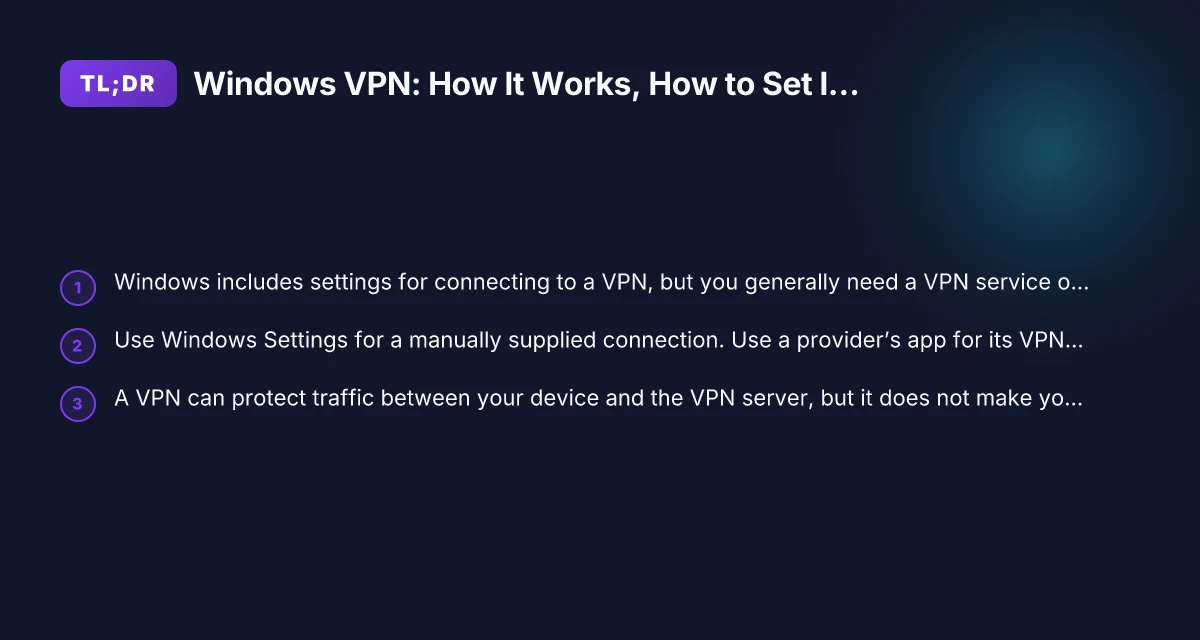
A Windows VPN is a connection that routes your internet traffic through a VPN server. Windows 10 and 11 include settings for adding and managing VPN connections, but those settings are not themselves a VPN service. To connect, you’ll need details from your employer, school, network administrator, or VPN provider, or you can install a provider’s Windows app and follow its setup instructions.
Editor's pick: NordVPN — fast, secure VPN — Strong encryption, a no-logs policy and apps for every device. 30-day money-back guarantee. Get NordVPN →
Compare VPN approaches for a Windows PC
| Option | What you need | Setup in Windows | What it protects | Best fit |
|---|---|---|---|---|
| Built-in VPN client | VPN provider or workplace details | Add a VPN connection in Settings | Traffic through the VPN server | Existing VPN subscriptions |
| Commercial VPN app | VPN subscription | Install the provider’s app | Traffic routed through the provider | Personal use and easy setup |
| Workplace VPN | Employer account and settings | Use company-provided instructions | Access to workplace network resources | Remote work |
| Manual VPN connection | Server address and sign-in details | Enter provider settings in Windows | Traffic routed through that VPN | Users with configuration details |
| No VPN | None | No VPN setup | No VPN tunnel | Ordinary browsing without a VPN |
Compiled November 2026; check the provider's site for current details.
| VPN | Obfuscation | From / month | Plan | Free plan | Refund | Alipay | UnionPay | Crypto | Website opens in China | Trustpilot | |
|---|---|---|---|---|---|---|---|---|---|---|---|
 ZoogVPN | Turn on manually Shadow | $2.49/mo | 27 months: $59.99 | Yes | 7 days | ✓ | ✓ | ✓ | ✓ | Official site blocked; our special link opens (4.4 s) | 4.2/5 (195 reviews) |
 NordVPN | Turn on manually Obfuscated Servers / NordWhisper | $3.49/mo | 27 months: $94.23 | No | 30 days | ? | ✗ | ✓ | ✓ | ✗ Blocked | 4.2/5 (51,628 reviews) |
 ExpressVPN | ✓ On by default all servers | $3.00/mo | 28 months: $84 | No | 30 days | ✗ | ✗ | ✓ | ✗ | ✗ Blocked | 4.4/5 (29,706 reviews) |
 Surfshark | ✓ On by default Camouflage, with OpenVPN | See site | See site | No | 30 days | ✗ | ✗ | ✗ | ✓ | ✗ Blocked | 4.3/5 (31,823 reviews) |
 Proton VPN | Turn on manually Stealth, free plan too | $2.99/mo | 12 months: $35.88 | Yes | 30 days | ✗ | ✗ | ✗ | ✓ | ✗ Blocked | 2.1/5 (1,040 reviews) |
 Astrill VPN | Turn on manually StealthVPN / OpenWeb | $12.50/mo | 24 months: $300 | No | See site | ✗ | ✗ | ✗ | ✓ | ✗ Blocked | 1.3/5 (110 reviews) |
 Private Internet Access | Turn on manually Shadowsocks, OpenVPN only | $2.03/mo | 40 months: $81.2 | No | 30 days | ✗ | ✗ | ✗ | ✗ | ✗ Blocked | 4.2/5 (11,033 reviews) |
 CyberGhost | Turn on manually selected servers | $2.19/mo | 28 months: $61.32 | No | 45 days | ✗ | ✗ | ✗ | ✓ | ✗ Blocked | 4.0/5 (24,178 reviews) |
 PureVPN | Turn on manually switch to OpenVPN | $1.69/mo | 60 months: $101.55 | No | 31 days | ? | ? | ✗ | ✓ | ✗ Blocked | 4.4/5 (17,994 reviews) |
 AdGuard VPN | ✓ On by default TrustTunnel | $2.99/mo | 24 months: $71.76 | Yes | 30 days | ✓ | ✗ | ✓ | ✓ | Official site blocked; our special link opens (3.7 s) | 4.3/5 (290 reviews) |
 Mullvad | Turn on manually QUIC / Shadowsocks / LWO | $5.61/mo | €5/mo | No | 14 days | ✗ | ✗ | ✗ | ✓ | ✗ Blocked | 3.2/5 (192 reviews) |
 Windscribe | Turn on manually Stealth / WStunnel | $5.75/mo | 12 months: $69 | Yes | See site | ✗ | ✗ | ✗ | ✓ | ✗ Blocked | 4.7/5 (13,355 reviews) |
 StrongVPN | Turn on manually Scramble, OpenVPN TCP | See site | See site | No | 30 days | ✓ | ✗ | ✗ | ✗ | ✗ Blocked | 4.4/5 (2,695 reviews) |
 LightXtreme 闪连 | Not listed | $7.08/mo | 12 months: $84.99 | Yes | 30 days | ✓ | ✓ | ✓ | ✓ | ✓ Yes (3.5 s) | No page |
Prices checked 2026-11-10 on each vendor's pricing page (cheapest long plan, USD). Check the vendor's checkout for the final price.
Obfuscation checked 2026-11-14 on each vendor's site and help center: "on by default" = nothing to set; "turn on manually" = switch protocol or mode in settings; "not listed" = the vendor describes no obfuscation.
Payment methods checked 2026-11-10 on each vendor's payment pages: all 14 take cards and PayPal; ✗ = not listed, ? = the vendor's own pages disagree.
China access: whether the official website opens from mainland China networks (tests the website only, not the VPN connection). Last checked 2026-11-18 01:02 Beijing time.
Trustpilot score and review count checked 2026-11-10.
Does Windows have a built-in VPN?
Windows has a built-in VPN client: a set of settings that lets you connect to compatible VPN servers. It does not automatically provide a VPN server, subscription, or service. In other words, Windows gives you a way to configure a connection, but you need a provider or organization to supply the connection details.
A VPN may be used to access a workplace or school network remotely, or to route internet traffic through a commercial VPN provider. Which option is right depends on your needs:
- Work or school access: Ask the organization’s IT team for setup instructions and credentials.
- Personal VPN service: Choose a provider and use its Windows app or configuration details.
- Manual setup: Use Windows’ VPN settings when you have the server and sign-in information required by the service.
Be cautious of websites or apps that suggest Windows already includes a free consumer VPN. The built-in settings are a connection tool, not a standalone service.
How to connect to a VPN in Windows
To set up a connection manually, open Settings and go to Network & internet > VPN > Add VPN. Microsoft’s instructions direct you to enter the information supplied by your VPN provider or organization. Free VPN for Microsoft Edge: What Works and What to Know
The exact fields and available connection options can vary depending on the server and configuration. You may need details such as the VPN provider type, connection name, server address, VPN type, and sign-in information. Get these directly from the organization or service you intend to use. Don’t guess at server or security settings.
After saving the connection, return to the VPN settings, select the connection, and choose Connect. If Windows reports an error, check the server address, credentials, and connection type against the instructions you were given. For a work or school VPN, contact the organization’s IT support if the details are correct but the connection still fails.
Manual setup or provider app?
A provider’s app is often the simpler route for a personal VPN. The app can handle the provider’s connection settings and may offer features that are not part of Windows’ basic VPN menu. Manual setup can make sense if the service specifically instructs you to use Windows’ built-in client or if an administrator has supplied a configuration.
| Option | Best suited to | What you need |
|---|---|---|
| Windows VPN settings | Work, school, or a service that supports manual connections | Connection details and sign-in information |
| VPN provider’s Windows app | Personal use with a commercial VPN service | The provider’s app and account or service setup |
Choose a Windows VPN by your priorities Edge Secure Network VPN Review: What It Protects, and What It Doesn’t
| Priority | What to look for | Check before choosing | Trade-off | Useful for |
|---|---|---|---|---|
| Easy setup | A dedicated Windows app | Windows version support | Less control over settings | New VPN users |
| Manual configuration | Support for Windows’ built-in client | Required protocols and server details | More setup work | Users with provider credentials |
| Privacy | A clear privacy policy | What data the provider collects | Policies vary by provider | Privacy-conscious browsing |
| Streaming | Servers suitable for your services | Whether the service works with your apps | Access can change | Watching content while connected |
| Workplace access | Employer-approved VPN | Required account and configuration | Not a substitute for a personal VPN | Remote employees |
| Reliable connection | Windows support and troubleshooting help | Network and firewall compatibility | Performance depends on connection and server | Frequent VPN users |
Compiled November 2026; check the provider's site for current details.
What a Windows VPN can, and cannot, do
A VPN creates an encrypted connection between your device and a VPN server. This can help protect your traffic while it travels across a network and can let you access resources that are available through that server. For remote work, it may provide a route into an organization’s private network.
A VPN is not a complete privacy shield. It does not guarantee anonymity, prevent every form of tracking, or make unsafe downloads and links safe. Websites can still identify you through account sign-ins, cookies, and other information. The VPN provider or organization operating the server may also have visibility into some aspects of the connection.
Use a VPN alongside sensible security practices: FortiClient VPN Windows 11: Install, Connect, and Troubleshoot
- Keep Windows and your VPN software updated.
- Use strong, unique passwords and multi-factor authentication where available.
- Download VPN software from the provider’s official website or a trusted app source.
- Review the provider’s privacy and logging policies before choosing a service.
- Disconnect from a work VPN when you no longer need access, following your organization’s guidance.
Choosing a VPN for Windows
If you want a personal VPN, compare providers based on privacy practices, security features, ease of use, and whether the service meets your needs. Check that the provider supports Windows and explains how to install and use its app. A polished app can simplify connecting, choosing a server, and managing settings, but its presence alone does not prove that a service is trustworthy.
Free VPN offers deserve careful review. “Free” does not automatically mean unsafe, but it also does not tell you how a provider funds its service or handles your data. Read the terms and privacy policy, check any limits, and be wary of claims that promise total anonymity or complete protection.
If you need a VPN for work or school, don’t choose a consumer service as a substitute for the organization’s connection. Follow its approved setup instructions, since the correct VPN may be configured for access to internal systems.
Troubleshooting common connection problems
If a Windows VPN won’t connect, first confirm that your internet connection works without the VPN. Then check the connection information and credentials against the details from your provider or administrator. VPN for Edge: How to Choose and Use One
You can also try these basic checks:
- Disconnect and reconnect, then restart the device if needed.
- Confirm that the VPN app or Windows settings are up to date.
- Check whether your account is active and your sign-in details are current.
- Ask your VPN provider or IT team whether the server is available or a specific connection type is required.
- Avoid changing advanced network or security settings unless support instructs you to do so.
For provider apps, use the provider’s own troubleshooting guidance. For managed work or school connections, your IT team is the best source for help.
Troubleshoot common Windows VPN connection problems
| Problem | Check first | Try this | If it persists | Likely area |
|---|---|---|---|---|
| VPN will not connect | Internet connection | Reconnect to the network | Contact the VPN provider or IT team | Network |
| Sign-in fails | Username and password | Re-enter account details | Reset credentials or ask your administrator | Account |
| Server cannot be reached | Server address | Confirm the address and VPN settings | Check provider status or workplace guidance | Configuration |
| Connection drops | Wi-Fi or Ethernet stability | Reconnect and try another network | Contact support with connection details | Network stability |
| VPN connects but a site will not load | Whether the site works without VPN | Try another server if available | Check provider or site restrictions | Site or server |
| Work resources remain unavailable | Workplace account and VPN profile | Follow your organization’s setup steps | Contact workplace IT | Workplace access |
Compiled November 2026; check the provider's site for current details. Chrome Urban VPN: How to Install, Use, and Assess the Extension
Recommendation
For a work or school connection, use the setup details and support provided by the organization. For personal use, choose a reputable VPN provider and install its Windows app unless the provider specifically recommends manual configuration. Windows’ built-in VPN settings are useful for connecting, but you still need a service or organization to provide the VPN connection.